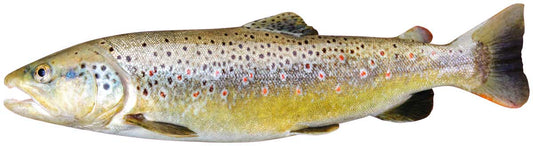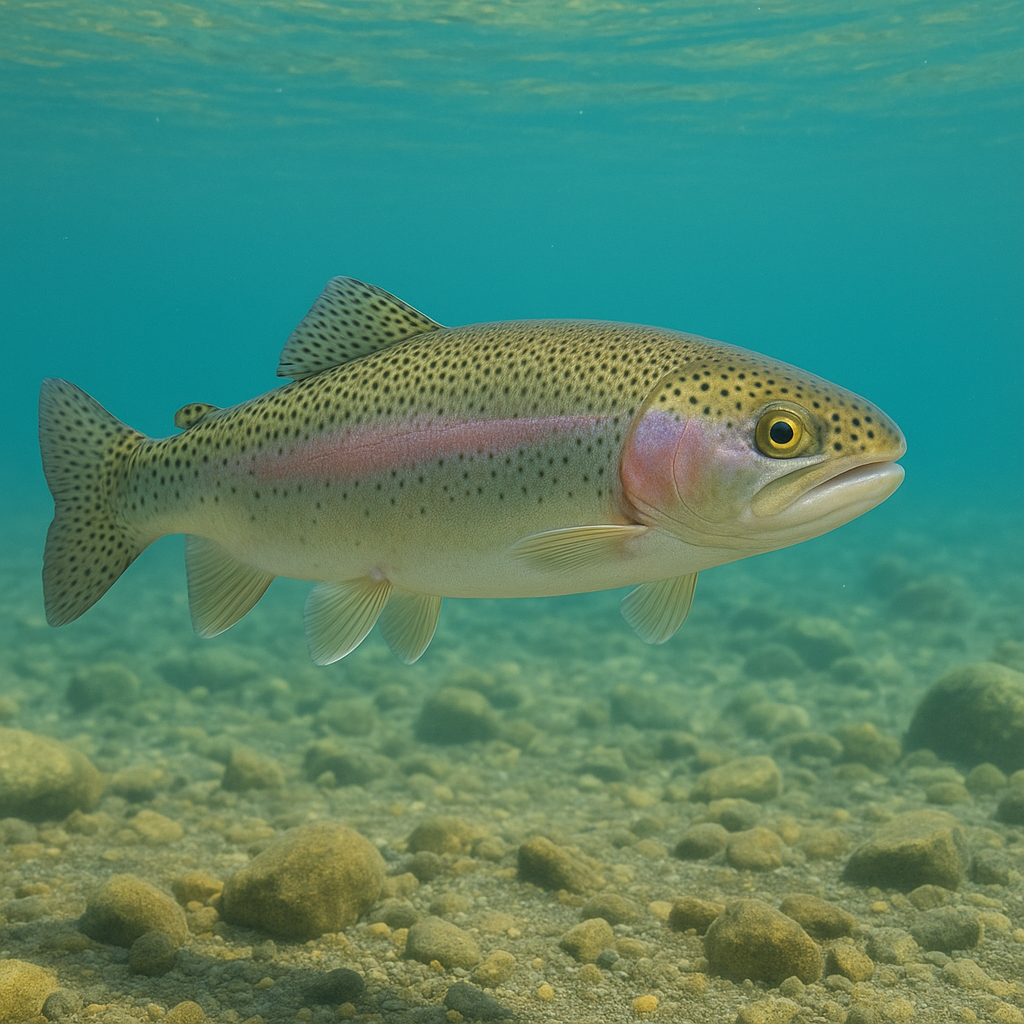
trout

20 to 60 cm in body length and 0.2 to 3 kg – that's what a grown trout reaches. As a carnivore, the trout eats insects, larvae, small crustaceans, small fish, and fish roe. Its life expectancy is 4 to 8 years.

  • Scientific classification

    • Class: Bony fishes (Actinopterygii)
    • Order: Salmoniformes
    • Family: Salmonidae
    • Genus: Salmo / Oncorhynchus
    • Species: S. trutta (brown trout), O. mykiss (rainbow trout)
  • Physical characteristics

    • Size: 20–60 cm, rainbow trout usually 30–60 cm
    • Weight: 0.2–3 kg, in exceptional cases up to 5 kg
    • Special features: Streamlined body, spotted scale pattern, silvery to greenish-brown plumage, strong tail fin, very agile swimmers
  • Habitat and distribution

    • Common regions: Europe, North America, Asia
    • Habitat: Flowing waters such as streams and rivers, lakes with cool, oxygen-rich water; prefers clear, rocky waters with currents
  • Nutrition

    • Diet: Carnivore
    • Typical food: insects, larvae, small crustaceans, small fish and fish eggs
  • Reproduction and lifestyle

    • Spawning season: autumn to winter (depending on region and species)
    • Eggs: 2,000-5,000 eggs per female
    • Lifestyle: Territorial, solitary except for spawning season; very agile and fast swimmers, sometimes migrating upstream for reproduction
  • Lifespan and protection status

    • Life expectancy: 4–8 years, brown trout can live up to 10 years
    • Threat status: Partially threatened by water pollution, overfishing and habitat changes
    • Protective measures: protection and renaturation of rivers and streams, stocking measures in fish-poor waters, water protection
  • This is how big the trout really is

    • Trout: 40 × 10 cm

    Dimensions of the life-size standees (width × height), printed at a 1:1 scale.

    To the exhibitors 

Vom Steckbrief zum Original – entdecke unsere Produkte rund um das Thema trout.

Jetzt entdecken